
Complete Chapter 13 question answers for Earth as a System: Energy, Matter, and Life, arranged in the supplied textbook order with full questions, student-friendly explanations, comparisons, case studies and extended-thinking answers.
NCERT Solutions
Think It Over
Q1How does the warming of Arabian Sea water affect the southwest monsoon in India?
The warming of the Arabian Sea water increases evaporation from the sea. This adds more water vapour to the atmosphere.
As a result:
• More moisture becomes available for the southwest monsoon.
• Monsoon winds may become stronger or more irregular.
• Some regions may receive heavy rainfall and floods.
• Other regions may receive less rainfall and face drought-like conditions.
Thus, warming of the Arabian Sea can cause fluctuations in the southwest monsoon and make rainfall more uneven in India.
Q2If a large forest is cleared, how can that affect the flow of a river in that area?
If a large forest is cleared, the flow of a river in that area can be badly affected.
Forests help in:
• Holding soil with roots
• Increasing water infiltration
• Reducing surface run off
• Maintaining groundwater recharge
• Supporting regular river flow
When forests are cleared:
• Less water enters the ground.
• More water flows quickly over the land as run off.
• Soil erosion increases.
• Rivers may flood during heavy rainfall.
• During dry months, rivers may have less water because groundwater recharge decreases.
So, deforestation can make river flow irregular, causing both floods and water shortage.
Q3What might happen to coastal cities in India if glaciers and polar ice keep melting faster?
If glaciers and polar ice keep melting faster, more water will enter the oceans. This will cause a rise in sea level.
Coastal cities in India such as Mumbai, Chennai and Kolkata may face:
• Flooding of low-lying areas
• Damage to buildings and roads
• Loss of coastal habitats
• Saltwater entering freshwater sources
• Threats to people living near the coast
In the long term, sea-level rise can make life difficult in many coastal cities.
Q4How would increasing carbon dioxide levels in the atmosphere affect the ocean plankton?
Increasing carbon dioxide levels in the atmosphere causes more CO₂ to dissolve in ocean water. This can make ocean water more acidic.
Ocean plankton may be affected because:
• Acidic water can disturb their growth.
• Many plankton use dissolved carbon compounds for photosynthesis.
• Changes in ocean temperature and chemistry can reduce plankton population.
• Since plankton form the base of many marine food chains, their decline can affect fish and other marine organisms.
Thus, increasing CO₂ can disturb plankton and the whole marine ecosystem.
NCERT Solutions
Pause and Ponder — Page 258
Q1Visit the website given below and study the effect of the concentration of greenhouse gas on surface temperature.
When the concentration of greenhouse gases such as carbon dioxide, methane and water vapour increases in the atmosphere, the surface temperature of the Earth also increases.
This happens because:
• The Earth’s surface absorbs solar radiation.
• It re-radiates heat in the form of infrared radiation.
• Greenhouse gases absorb some of this outgoing heat.
• More greenhouse gases trap more heat.
• This causes the Earth’s surface temperature to rise.
Therefore, an increase in greenhouse gas concentration leads to enhanced greenhouse effect and global warming.
NCERT Solutions
Pause and Ponder — Page 261
Q2How does the cool mountain breeze benefit agriculture activity, particularly the crops and soil?
A cool mountain breeze blows down the mountain slopes into the valley at night. It benefits agriculture in the following ways:
• It helps in cooling the crops during the night.
• It reduces excessive heat stress on plants.
• It helps maintain soil moisture.
• It can reduce evaporation from soil.
• It supports healthy crop growth in hilly regions.
• It helps regulate local temperature and moisture conditions.
Thus, mountain breeze supports soil health and crop growth, especially in mountainous agricultural areas.
Q3What happens to the warm surface water from the equator as it travels toward the poles? What impact does this movement have on the area?
Warm surface water from the equator moves towards the poles through ocean currents.
As it travels:
• It carries heat from the equatorial region to colder regions.
• It gradually loses heat and becomes cooler.
• Colder and denser water may sink and move back towards the equator at deeper levels.
Impact of this movement:
• It reduces temperature differences between the equator and poles.
• It warms colder coastal regions.
• It affects climate and weather patterns.
• It supports marine life by transporting nutrients.
For example, the North Atlantic Drift carries warm water towards northwestern Europe and helps keep many ports ice-free during winter.
NCERT Solutions
Pause and Ponder — Page 263
Q4The CO₂ dissolved in the ocean is disturbed when the global temperature increases. What will happen to marine life?
When global temperature increases, the balance of dissolved CO₂ in ocean water is disturbed.
This can affect marine life in many ways:
• Warmer ocean water absorbs less CO₂.
• Excess CO₂ can make ocean water more acidic.
• Acidic water can harm plankton and coral reefs.
• Marine organisms that make shells may find it difficult to form shells.
• Fish and other marine animals may lose food sources.
• Marine food chains may get disturbed.
Thus, rising global temperature and disturbed CO₂ balance can damage marine ecosystems.
NCERT Solutions
Pause and Ponder — Page 265
Q5What would happen to plants and animals on Earth if the biogeochemical cycles were disrupted and stopped? Explain by giving a few examples.
If biogeochemical cycles were disrupted and stopped, life on Earth would be seriously affected because essential nutrients would no longer be recycled.
Examples:
• If the water cycle stops, rainfall will not occur properly. Plants will dry up, and animals will not get enough water.
• If the carbon cycle stops, plants will not get enough carbon dioxide for photosynthesis. Food production will decrease.
• If the nitrogen cycle stops, plants will not get nitrogen compounds needed to make proteins. Plant growth will become poor.
• If the oxygen cycle stops, oxygen levels may decrease, affecting respiration in animals and humans.
Biogeochemical cycles keep nutrients moving between air, water, soil and living organisms. Without these cycles, ecosystems would collapse, and plants and animals would not survive.
NCERT Solutions
Pause and Ponder — Page 266
Q6Discuss how human activities increase the concentration of greenhouse gases in the atmosphere. What would you do as an individual to reduce the emission of greenhouse gas?
Human activities increase greenhouse gases mainly by releasing more carbon dioxide, methane and other gases into the atmosphere.
Major human activities responsible for this are:
• Burning of fossil fuels like coal, petrol, diesel and natural gas
• Deforestation
• Industrial activities
• Vehicular emissions
• Excessive use of electricity from fossil fuels
• Burning of waste
• Unsustainable farming practices
These gases trap more heat in the atmosphere and cause global warming and climate change.
As an individual, I can reduce greenhouse gas emissions by:
• Saving electricity
• Switching off lights, fans and appliances when not in use
• Using public transport, cycling or walking whenever possible
• Planting trees
• Reducing waste
• Reusing and recycling materials
• Saving water
• Avoiding unnecessary use of plastic
• Using solar energy where possible
• Avoiding food wastage
Small actions by individuals can help reduce greenhouse gas emissions and protect the Earth’s environment.
NCERT Solutions
Revise, Reflect, Refine — Question Answers
Q1Choose the most appropriate option to describe the role of biogeochemical cycles in an ecosystem. (i) To provide food directly to all organisms. (ii) To recycle essential nutrients between biotic and abiotic components. (iii) To create new elements for use by living things. (iv) To remove pollutants and toxins from the organism.
The correct option is (ii) To recycle essential nutrients between biotic and abiotic components.
Explanation:
Biogeochemical cycles help in the continuous movement of nutrients such as water, carbon, nitrogen and oxygen between living organisms and non-living components like air, water, soil and rocks.
They do not create new elements. Instead, they recycle existing nutrients and make them available again for living organisms.
Q2Which of the following is primarily responsible for warming of the Earth? (i) Solar radiation is immediately absorbed by carbon dioxide, which then releases it as heat. (ii) The atmosphere’s tiny particles absorb incoming solar radiation, which directly heats the Earth. (iii) The Earth’s surface absorbs solar radiation, which is then re-radiated and trapped by greenhouse gases. (iv) The Earth’s environment is heated only by the solar radiation reflected by the clouds.
The correct option is (iii) The Earth’s surface absorbs solar radiation, which is then re-radiated and trapped by greenhouse gases.
Explanation:
The Earth’s surface absorbs energy from the Sun. Then it re-radiates this energy as infrared radiation. Greenhouse gases such as carbon dioxide, methane and water vapour trap some of this outgoing heat and keep the Earth warm enough for life.
This process is called the greenhouse effect.
Q3Explain how climate change affects the water cycle. Illustrate with examples.
Climate change affects the water cycle by changing the pattern of evaporation, rainfall, snowfall, river flow and groundwater recharge.
Due to global warming:
• A warmer atmosphere holds more water vapour.
• Some areas receive heavier rainfall.
• Some regions face droughts.
• Glaciers melt faster.
• Sea level rises.
• Sudden heavy rainfall increases run off and soil erosion.
• Less water seeps into the ground, reducing groundwater recharge.
Examples:
• Intensified monsoons can cause floods in some parts of India.
• Melting Himalayan glaciers can increase river flow in the short term but may reduce water availability in the long term.
• Coastal cities such as Mumbai and Chennai may face threats due to sea-level rise.
• Less infiltration can make agriculture difficult during dry months.
Thus, climate change disturbs the balance of the hydrosphere, cryosphere, atmosphere, geosphere and biosphere.
Q4Describe how albedo affects the Earth’s surface temperature and its climate.
Albedo is the fraction of solar radiation reflected by a surface.
• Surfaces with high albedo reflect more sunlight and remain cooler.
• Surfaces with low albedo absorb more sunlight and become warmer.
Examples:
• Snow and ice have high albedo, so they reflect much of the sunlight. This helps keep polar regions cold.
• Black soil, dark roads and ocean water have low albedo, so they absorb more sunlight and heat up more.
Albedo affects climate because it controls how much solar energy is absorbed by the Earth’s surface.
For example:
• If snow and ice melt, darker land or ocean water gets exposed.
• These darker surfaces absorb more heat.
• This causes further warming and more ice melting.
Thus, albedo plays an important role in maintaining the Earth’s temperature and climate balance.
Q5How are mountain and valley breezes formed? Suppose there are two mountains, one covered with grass and another covered with barren rocks; would the temperature of the two mountain breezes be different? If so, how?
Valley breeze and mountain breeze are local winds formed due to unequal heating and cooling of mountain slopes and valley floors.
Formation of Valley Breeze
During the day:
• Mountain slopes heat up faster than the valley floor.
• Air over the slopes becomes warm and rises.
• Cooler air from the valley moves up the slopes.
This upward movement of air is called valley breeze.
Formation of Mountain Breeze
At night:
• Mountain slopes cool faster.
• Air over the slopes becomes cool and dense.
• This cool air flows down into the valley.
This downward movement of air is called mountain breeze.
Difference between Grass-covered and Barren Mountain
Yes, the temperature of the breezes from the two mountains would be different.
• A grass-covered mountain would remain cooler because plants provide shade and cool the air through transpiration.
• A barren rocky mountain would heat up more during the day and release more heat at night because rocks absorb and retain more solar radiation.
Therefore, the breeze from the barren rocky mountain may be warmer, while the breeze from the grass-covered mountain may be cooler and more moist.
Q6You have witnessed weather phenomena, such as winds, storms, rainfall, etc. Which atmospheric layer is mainly responsible for such phenomena and what is the primary reason for its occurrence?
The atmospheric layer mainly responsible for weather phenomena such as winds, storms, clouds and rainfall is the troposphere.
The primary reason is that the troposphere is heated from the Earth’s surface.
In the troposphere:
• Warm air rises.
• Cool air sinks.
• Water vapour condenses to form clouds.
• Air movement causes winds and storms.
• Temperature generally decreases with height.
Since most water vapour, clouds and air movements are found in the troposphere, almost all weather events occur in this layer.
Q7Explain the processes involved in the nitrogen cycle. How would life on Earth be affected if nitrogen were not cycled?
The nitrogen cycle is the movement of nitrogen between the atmosphere, soil, water and living organisms.
Nitrogen is essential for making proteins, DNA and RNA, but plants and animals cannot directly use atmospheric nitrogen gas.
The main processes of the nitrogen cycle are:
1. Nitrogen Fixation
Atmospheric nitrogen is converted into ammonia by nitrogen-fixing bacteria.
Examples:
• Rhizobium in root nodules of leguminous plants
• Azotobacter in soil
Lightning also fixes a small amount of nitrogen.
2. Nitrification
Ammonia is converted into nitrites and then nitrates by nitrifying bacteria.
• Nitrosomonas converts ammonia into nitrite.
• Nitrobacter converts nitrite into nitrate.
3. Assimilation
Plants absorb nitrates from the soil and use them to make proteins and other nitrogen compounds.
Animals get nitrogen by eating plants or other animals.
4. Ammonification
When plants and animals die or produce waste, decomposers break down organic matter and release ammonia into the soil.
5. Denitrification
Denitrifying bacteria such as Pseudomonas convert nitrates back into nitrogen gas, which returns to the atmosphere.
Effect if Nitrogen Were Not Cycled
If nitrogen were not cycled:
• Plants would not get usable nitrogen compounds.
• Protein formation in plants would stop.
• Plant growth would become poor.
• Animals would not get enough nitrogen through food.
• Food chains would be disturbed.
• Ecosystems would collapse.
Thus, the nitrogen cycle is essential for life on Earth.
Q8What are the impacts of deforestation on the Earth’s oxygen and carbon cycles? What are the other consequences of deforestation?
Deforestation means large-scale cutting or clearing of forests.
Impact on Oxygen Cycle
Forests release oxygen through photosynthesis. When forests are cleared:
• Photosynthesis decreases.
• Oxygen production decreases.
• The oxygen cycle is disturbed.
Impact on Carbon Cycle
Trees absorb carbon dioxide during photosynthesis. When forests are cut:
• Less CO₂ is absorbed from the atmosphere.
• More CO₂ remains in the air.
• Burning or decay of cut trees releases stored carbon.
• Greenhouse effect and global warming increase.
Other Consequences of Deforestation
Deforestation also causes:
• Soil erosion
• Reduced rainfall
• Less transpiration
• Loss of biodiversity
• Destruction of habitats
• Increase in floods
• Reduction in groundwater recharge
• Disturbance in the water cycle
• Change in surface albedo
• Climate imbalance
Thus, deforestation affects the oxygen cycle, carbon cycle, water cycle, soil and living organisms.
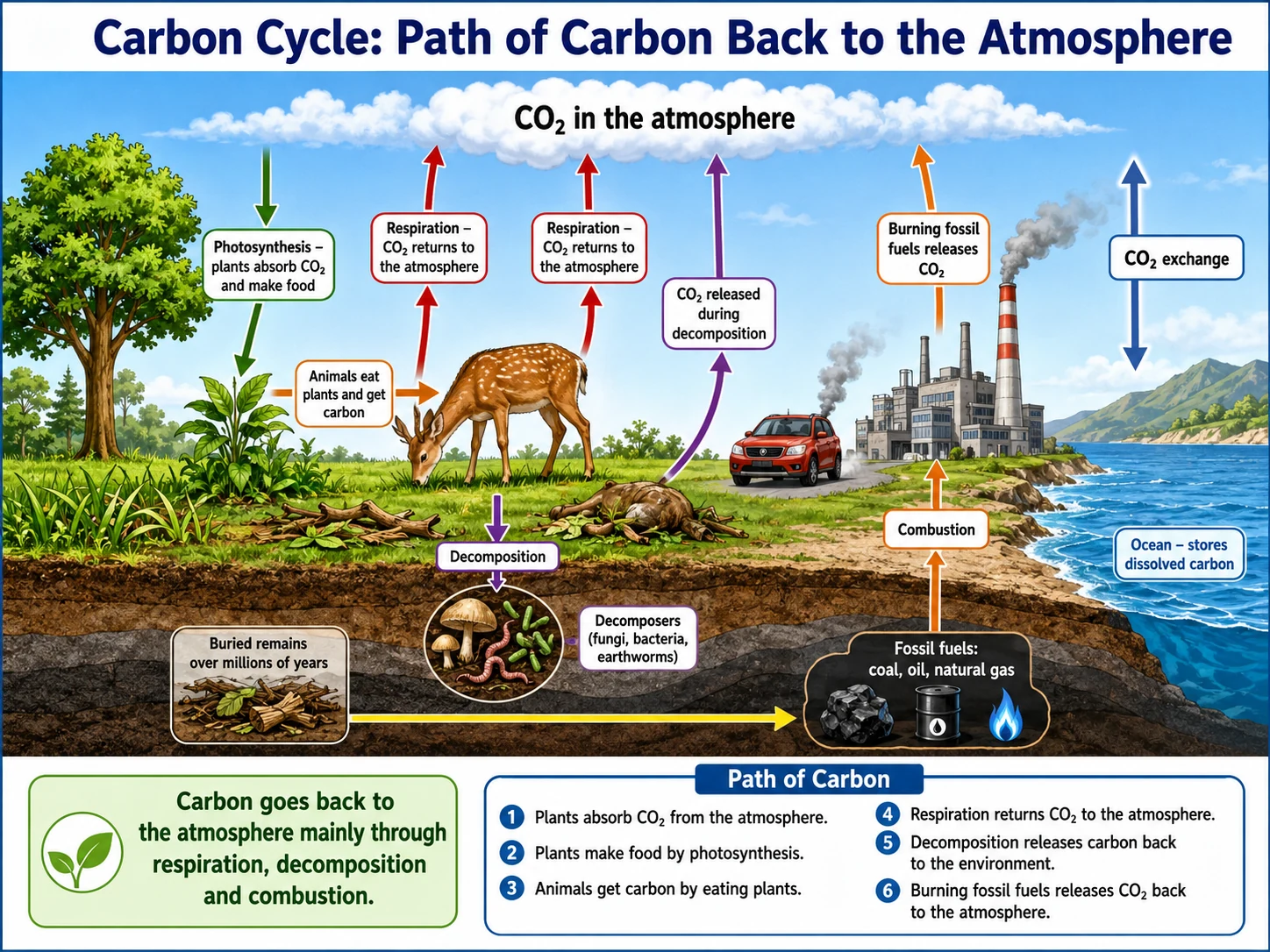
Q9Explain with suitable diagram the path that carbon takes to go back to the atmosphere. You may start from plants using CO₂ from the atmosphere.
Carbon moves between the atmosphere, plants, animals, soil, oceans and fossil fuels through the carbon cycle.
Plants absorb carbon dioxide from the atmosphere during photosynthesis and convert it into food. This carbon then moves to animals when they eat plants. Carbon returns to the atmosphere through respiration, decomposition and combustion.
Path of Carbon
• Plants take CO₂ from the atmosphere.
• Plants use CO₂ in photosynthesis to make food.
• Animals eat plants and get carbon.
• Plants and animals release CO₂ during respiration.
• Dead plants and animals are broken down by decomposers.
• Decomposition releases carbon back into the environment.
• Some dead organisms get buried and form fossil fuels over millions of years.
• Burning fossil fuels releases CO₂ back into the atmosphere.
Diagram of Carbon Cycle
Thus, carbon goes back to the atmosphere mainly through respiration, decomposition and burning of fossil fuels.
Q10Why is an excess of CO₂ in the atmosphere considered undesirable even though it is required by plants?
Carbon dioxide is required by plants for photosynthesis, but excess CO₂ in the atmosphere is undesirable.
This is because CO₂ is a greenhouse gas. When its concentration increases, it traps more heat in the atmosphere.
Excess CO₂ causes:
• Enhanced greenhouse effect
• Global warming
• Melting of glaciers and polar ice
• Sea-level rise
• Extreme weather events
• More intense monsoons
• Droughts in some regions
• Ocean acidification
• Harm to marine life
• Disturbance in agriculture
Thus, CO₂ is useful in small amounts, but excess CO₂ disturbs the Earth’s climate balance.
Q11How is heat lost from the surface of the Earth? What is its significance?
Heat is lost from the Earth’s surface mainly by re-radiation.
The Earth’s surface absorbs solar radiation during the day. Later, it releases this absorbed heat back in the form of infrared radiation.
Some of this outgoing heat escapes into space, while some is absorbed by greenhouse gases such as carbon dioxide, methane and water vapour.
Significance
• It helps maintain the Earth’s energy balance.
• It prevents the Earth from becoming too hot.
• The trapping of some heat by greenhouse gases keeps Earth warm enough for life.
• Without this process, Earth would be too cold for living organisms.
• If too much heat is trapped due to excess greenhouse gases, it causes global warming.
Thus, heat loss from Earth’s surface is important for maintaining a suitable temperature for life.
Q12If the Earth were a flat disc instead of a sphere, how would the patterns of solar radiation and temperature be different?
If the Earth were a flat disc instead of a sphere, the pattern of solar radiation would be very different.
On the spherical Earth:
• Sun’s rays fall directly near the equator.
• Sun’s rays fall slanting near the poles.
• This causes unequal heating and different temperature zones.
But if the Earth were a flat disc:
• Sun’s rays would fall at nearly the same angle over a large part of the surface.
• Solar radiation would be more evenly distributed.
• Temperature differences between regions would be less.
• Equator-to-pole temperature variation would not exist in the same way.
• Global wind patterns and ocean currents would be very different.
Thus, the spherical shape of the Earth is responsible for the present pattern of solar heating, temperature zones, winds and ocean currents.
Q13Suppose there is a rise in atmospheric temperature on Earth. How would this affect the cryosphere, hydrosphere and biosphere?
A rise in atmospheric temperature would affect the cryosphere, hydrosphere and biosphere in many ways.
Effect on Cryosphere
The cryosphere includes snow, glaciers and polar ice.
A rise in temperature would cause:
• Faster melting of glaciers
• Melting of polar ice caps
• Reduction in snow cover
• Shrinking of Himalayan glaciers
Effect on Hydrosphere
The hydrosphere includes oceans, rivers, lakes and groundwater.
A rise in temperature would cause:
• Sea-level rise due to melting ice
• More evaporation from water bodies
• Changes in rainfall patterns
• More floods in some areas
• Droughts in some regions
• Warmer ocean water
• Disturbance in ocean currents
Effect on Biosphere
The biosphere includes all living organisms and their habitats.
A rise in temperature would cause:
• Habitat loss
• Stress on plants and animals
• Decline in biodiversity
• Disturbance in food chains
• Damage to coral reefs and plankton
• Reduced crop productivity in some areas
Thus, a rise in atmospheric temperature can disturb the delicate balance among Earth’s spheres.
Q14Explain how the Earth’s atmosphere helps in maintaining a suitable temperature for life to survive on the Earth.
The Earth’s atmosphere helps maintain a suitable temperature for life through the greenhouse effect.
The atmosphere allows most visible sunlight to reach the Earth’s surface. The Earth absorbs this solar energy and becomes warm. Then the Earth re-radiates heat as infrared radiation.
Greenhouse gases such as:
• Carbon dioxide
• Methane
• Water vapour
absorb some of this outgoing heat and prevent it from escaping completely into space.
This keeps the Earth warm enough for life.
The atmosphere also:
• Absorbs harmful ultraviolet radiation through the ozone layer
• Reduces extreme temperature differences between day and night
• Supports weather and water cycle
• Protects life from harmful radiation
Without the atmosphere, the Earth would become too cold for most living organisms to survive. However, excess greenhouse gases can trap too much heat and cause global warming.
Q15Describe the interrelationship between different spheres of the Earth. Illustrate with example how these spheres function in a delicate balance.
The Earth is made up of different interconnected spheres:
• Geosphere: Rocks, soil, landforms and Earth’s interior
• Hydrosphere: Water in oceans, rivers, lakes and groundwater
• Cryosphere: Snow, glaciers and ice
• Atmosphere: Air surrounding the Earth
• Biosphere: Living organisms and their habitats
These spheres are closely connected. A change in one sphere affects the others.
Example: Less Snowfall in Mountains
If snowfall decreases:
• The cryosphere is affected because there is less snow and ice.
• Less snow melts in summer, so rivers and lakes get less water. This affects the hydrosphere.
• Less water reduces soil moisture and plant growth. This affects the biosphere.
• Dry soil and reduced vegetation affect the geosphere.
• Changes in evaporation and moisture affect the atmosphere.
Another Example: Deforestation
When forests are cleared:
• The biosphere loses plants and animals.
• The atmosphere gets more CO₂ because fewer trees absorb it.
• The hydrosphere is affected because less transpiration may reduce rainfall.
• The geosphere is affected because soil erosion increases.
Thus, Earth’s spheres function in a delicate balance, and disturbance in one sphere can disturb the whole Earth system.
NCERT Solutions
The Quest Continues
QuestionNew tools are allowing scientists to observe the planet in real time and uncover hidden connections between climate, ecosystems, and human activity. What new discoveries will these tools reveal about the changing Earth, and how will they improve our understanding of global warming and climate change?
New scientific tools such as satellites, sensors, ocean buoys, weather stations, drones and computer models help scientists observe the Earth in real time.
These tools may reveal new discoveries about:
• Changes in global temperature
• Melting of glaciers and polar ice
• Rising sea levels
• Changes in ocean currents
• Changes in monsoon patterns
• Loss of forests and biodiversity
• Increase in greenhouse gases
• Ocean warming and acidification
• Changes in rainfall and drought patterns
• Effects of human activities on ecosystems
These tools improve our understanding of global warming and climate change by:
• Providing accurate data from different parts of the Earth
• Helping scientists predict floods, droughts and storms
• Showing how climate change affects plants, animals and humans
• Helping governments plan better climate policies
• Improving weather and monsoon forecasts
• Showing the link between human activities and environmental change
For example, satellites can track forest loss, glacier melting and sea-level rise. Ocean buoys can measure sea temperature and help understand monsoon changes. Computer models can predict future climate conditions.
Thus, modern tools help scientists understand the changing Earth more clearly and take steps to protect the planet.
Open the separate chapter notes page for this same chapter.
Open Chapter NotesReturn to the Class 9 Exploration chapter list.
View all chapters