
Complete exercise answers for Chapter 7, covering pitch, resonance, the human voice, tāla calculations, vocal care, rhythmic phrases, and instrument design.
Question Answers
Exercises
Q1Fill in the blanks.
i. When a string is tightened, the pitch ________.
Answer: When a string is tightened, the pitch increases.
ii. The diaphragm and lungs form part of the ________ subsystem.
Answer: The diaphragm and lungs form part of the air pressure subsystem.
iii. The hollow body of a musical instrument is important because ________.
Answer: The hollow body of a musical instrument is important because it increases the loudness and enhances the sound by resonance.
Q2State whether the following statements are true or false.
i. The thickness of a string affects the quality of sound. (True/ False)
Answer: True
The thickness or material of the string changes the quality or tone of the sound.
ii. Drinking water is bad for the voice. (True/ False)
Answer: False
Drinking sufficient water is good for the voice because it keeps the vocal cords hydrated.
iii. C.V. Raman conducted experiments on the sound of the veena. (True/ False)
Answer: False
C.V. Raman conducted experiments on the sound of the mṛidaṅgam and tabla, not the veena.
Q3Name the three subsystems of the human vocal system, and describe the function of each.
The three subsystems of the human vocal system are:
Air Pressure System:
It includes the diaphragm, lungs, and surrounding muscles. It provides air pressure and breath support for producing voice.
Vibratory System:
It includes the larynx or voice box and vocal folds. The vocal folds vibrate when air passes through them and produce sound.
Resonating System:
It includes the throat, mouth, and nasal cavities. It shapes, amplifies, and improves the quality of the sound.
Q4Describe some ways to ensure our voices are in good condition.
We can keep our voices in good condition by drinking enough water, eating a healthy diet, and avoiding very oily or acidic food. We should not shout or speak too loudly for a long time. Speaking at a moderate volume protects the voice. Regular vocal warm-ups like breathing exercises, humming, lip trills, and sargam practice also help keep the voice healthy.
Q5Jhaptāla has 10 beats (mātras) in a cycle (āvartana), and Kehervā (Tāla) has 8 beats. After how many beats will they both complete full cycles together?
Jhaptāla has 10 beats and Kehervā has 8 beats.
To find when they complete full cycles together, we find the LCM of 10 and 8.
Multiples of 10: 10, 20, 30, 40
Multiples of 8: 8, 16, 24, 32, 40
So, the LCM of 10 and 8 is 40.
Therefore, both Jhaptāla and Kehervā will complete full cycles together after 40 beats.
Q6Describe a warm-up routine that can be done daily to keep the voice in good condition.
A daily vocal warm-up routine can include the following exercises:
Breathing and diaphragm exercise:
Sit or stand straight. Inhale deeply through the nose, hold for 2–3 seconds, and exhale slowly through the mouth.
Humming:
Hum at a comfortable pitch and feel the vibration in the lips, nose, and chest.
Lip trills or bubbles:
Blow air through closed lips while making a “brrr” sound. Glide up and down in pitch.
Sargam exercises:
Sing simple sargam patterns like SGR, RMG, GPM and SRGM, RGMP, GMPD at different speeds.
These exercises improve breath control, resonance, flexibility, and vocal strength.
Q7Write a Konnakkol/ Bol phrase for:
i. 5 akṣharas
Answer: taka takita
It has 5 akṣharas: 2 + 3.
ii. 6 akṣharas
Answer: takita takita
It has 6 akṣharas: 3 + 3.
Another possible phrase is taka taka taka, which is 2 + 2 + 2.
Q8Describe the connection between the science of sound and musical instruments (50 words).
The science of sound explains how musical instruments produce different sounds. Sound is produced by vibrations. Tightening or loosening strings changes pitch, hollow bodies increase loudness, and thickness or material changes sound quality. These principles help in designing and playing instruments like sitar, flute, tabla, veena, and mṛidaṅgam.
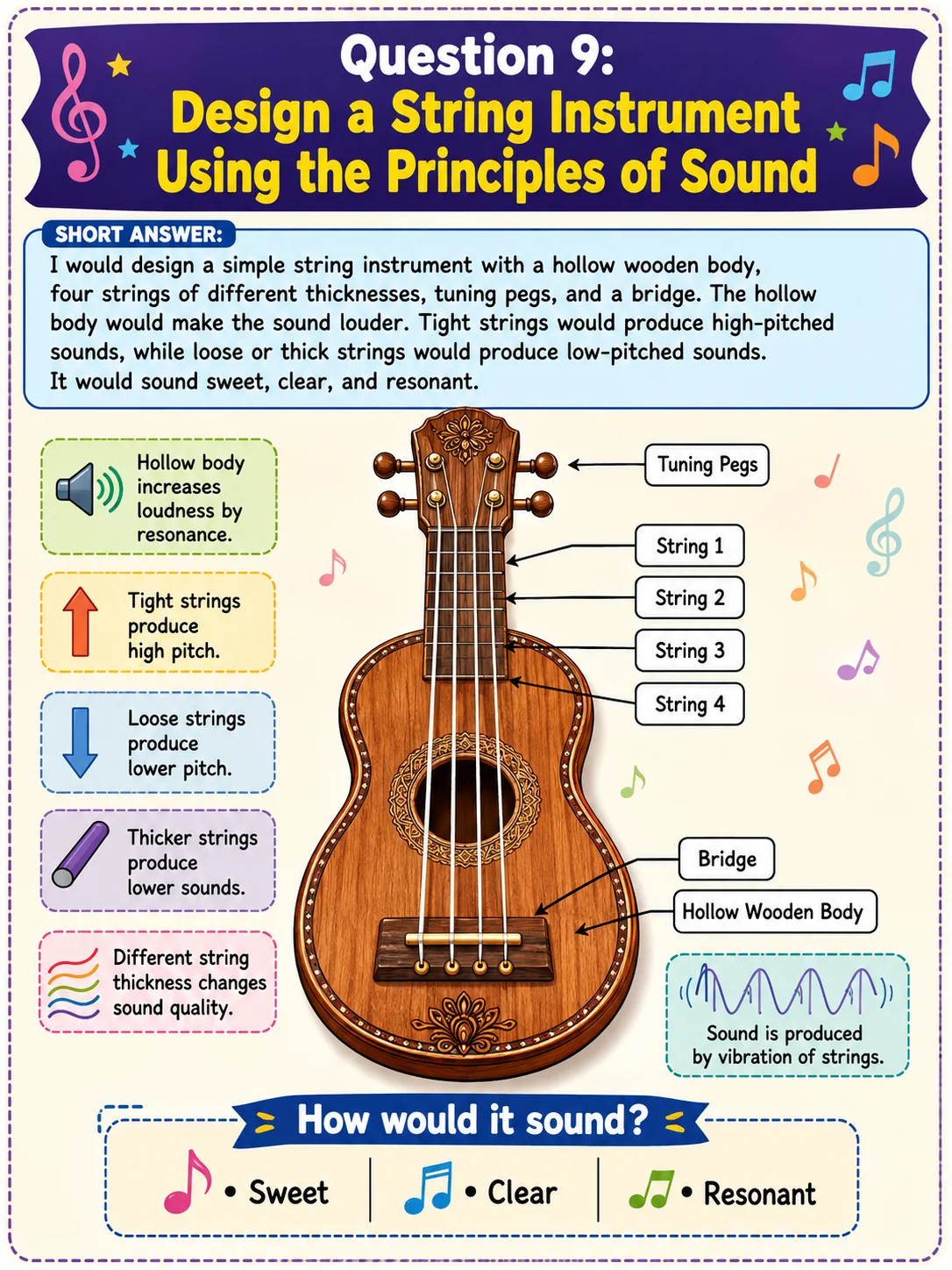
Q9If you were to design a string instrument using the principles of sound, how would it look and sound? Draw a diagram.
I would design a simple string instrument with a hollow wooden body, four strings of different thicknesses, tuning pegs, and a bridge. The hollow body would make the sound louder. Tight strings would produce high-pitched sounds, while loose or thick strings would produce low-pitched sounds. It would sound sweet, clear, and resonant.
Diagram:
Q10Which category of instrument (tata, suṣhira, avanaddha, ghana) does the human voice belong to? Justify your answer.
The human voice is closest to the suṣhira-vādya or wind instrument category.
This is because the human voice is produced when air from the lungs passes through the vocal folds. The vocal folds vibrate and the sound is shaped by the throat, mouth, and nasal cavities. Like wind instruments, the human voice depends on controlled airflow to produce sound.
Open the separate notes / explanation page for this same chapter.
Open Notes / ExplanationReturn to the complete Madhurima chapter list.
View all chapters