Complete activity, scene-work, discussion-circle, and exercise answers for Chapter 3, including all supplied tables and diagrams.
Question Answers
Activity 3.1 – Beyond Words
Q1What do you think is implied by the two levels created on stage?
The two levels on the stage may represent difference in power, status, importance, or emotions. The higher level may show authority, dominance, dreams, or superiority, while the lower level may show common people, weakness, struggle, or sadness. It can also show two different worlds, such as past and present, rich and poor, or reality and imagination.
Q2What is the first object that caught your attention? What do you think it represents?
The first object that caught my attention is the raised platform on the stage. I think it represents power, importance, or a special place where a main character may appear. It may also symbolise distance between people, such as the difference between a ruler and common people.
Question Answers
Symbolism Using Music – Peace Treaty Scene
The chapter explains that music can change how the audience understands a scene. For example, different sounds or instruments can make a character appear calm, dangerous, sad, or powerful.
Scene 1: Two kings signing a peace treaty after a battle
Q1What is the mood of the scene?
The mood of the scene is serious, tense, royal, and slightly sorrowful. Although a peace treaty is going to be signed, the regional ruler is unhappy with the terms.
Q2How would the rhythm pattern be to represent that mood?
The rhythm pattern should be slow, heavy, and tense. It should not be very fast because the scene is serious. A slow drumbeat can show pressure and political tension.
Q3Which instruments would you use, considering the time and place?
I would use nagara, dhol, mridangam, shehnai, conch, and low-pitched string instruments. These instruments can create a royal and historical atmosphere.
Q4Would you need vocals/lyrics, or is instrumental music better?
Instrumental music would be better because it can create a serious atmosphere without disturbing the dialogue or action. Soft background chanting or humming may be used during the treaty scene.
Question Answers
Symbolism Using Music – Hospital Waiting Room
Q1What is the mood of the scene?
The mood of the scene is anxious, emotional, uncertain, and realistic. Each person is waiting with worry and hope.
Q2How would the rhythm pattern be to represent that mood?
The rhythm pattern should be slow and filled with pathos, with a repeated soft beat like a heartbeat or clock ticking. This can show waiting, fear, and uncertainty.
Q3Which instruments would you use, considering the time and place?
I would use soft piano, flute, light percussion, and heartbeat-like sound effects. Hospital sounds such as distant footsteps, announcement bell, and clock ticking may also be used.
Q4Would you need vocals/lyrics, or is instrumental music better?
Instrumental music is better because it keeps the scene realistic. A soft humming sound may be used to show emotional pain and hope.
Question Answers
Costumes and Make-up – Peace Treaty Scene
Costumes can show time period, social status, culture, and personality. Heavy fabrics may suggest royalty, while simple cotton may suggest humility. Make-up can show age, experience, burden, innocence, or inner conflict.
Scene 1: Peace treaty after a battle
Q1List out all the characters in the scene. List out the details of age, gender, and situation of each character.
| Character | Age/Gender | Situation |
|---|---|---|
| Emperor | Middle-aged male | Powerful ruler, confident and dominant |
| Regional ruler | Middle-aged male | Forced to accept the treaty, unhappy |
| Chief advisor of emperor | Older male/female | Supports emperor’s political decision |
| Chief advisor of regional ruler | Older male/female | Worried about ruler’s loss |
| Army commanders | Adult males/females | Represent military power |
| Emperor’s queen | Adult female | Graceful and royal |
| Emperor’s daughter | Young female | Observing the political event |
Q1Which material or fabric would they use? What colours would the character wear?
The emperor may wear silk or brocade in red, gold, and purple to show power and royalty. The regional ruler may wear slightly dull royal clothes in grey, blue, or faded gold to show sadness and defeat. Advisors may wear cotton-silk robes in sober colours. Army commanders may wear leather-like armour or structured costumes in brown, black, or metallic shades. The queen and daughter may wear rich silk costumes with royal colours.
Q2Is there any specific motif or pattern on the costume that can represent their cultural background?
Yes, royal motifs such as sun, lion, elephant, sword, lotus, or border designs can be used. The emperor’s costume may have bold and large motifs to show power, while the regional ruler’s costume may have local patterns to represent his region and identity.
Q3How could you show the state of mind of the character through their costume and make-up?
The emperor’s costume should be neat, bright, and grand to show confidence. The regional ruler’s costume may be slightly crushed or less bright to show emotional pain and helplessness. His make-up may include tired eyes and a serious face. The advisors may look worried, while the commanders may have firm expressions.
Q4Which accessories would each character wear or use?
The emperor may wear a crown, heavy necklace, rings, and carry a royal seal. The regional ruler may wear a smaller crown or turban and carry a sword. Advisors may carry scrolls or documents. Commanders may carry swords or shields. The queen may wear jewellery and a veil, while the daughter may wear simple royal ornaments.
Q5Which key elements will you include for each that prominently represent the characters?
For the emperor, I would include a large crown and royal seal. For the regional ruler, I would include a sword kept down, showing his helplessness. For advisors, I would include scrolls and treaty papers. For army commanders, I would include weapons and armour. For the queen and daughter, I would include royal jewellery and graceful costumes.
Question Answers
Costumes and Make-up – Hospital Waiting Room
Q1List out all the characters in the scene. List out the details of age, gender, and situation of each character.
| Character | Age/Gender | Situation |
|---|---|---|
| Sales employee | 28-year-old male/female | Injured in an accident |
| Old woman | Elderly female | Waiting for medical help |
| Son of old woman | Adult male | Worried for his mother |
| Mother | 30-year-old female | Worried about her child |
| Child | 3-year-old boy | Sick or restless |
Q1Which material or fabric would they use? What colours would the character wear?
The sales employee may wear a formal shirt and trousers, slightly torn or stained due to the accident. The old woman may wear a simple cotton sari in light colours. Her son may wear simple everyday clothes. The mother may wear a cotton kurta or sari in dull colours to show worry. The child may wear bright but slightly messy clothes.
Q2Is there any specific motif or pattern on the costume that can represent their cultural background?
Yes, the old woman’s sari may have a traditional border. The mother’s dress may have simple Indian patterns. The sales employee may have an office ID card to show his working background.
Q3How could you show the state of mind of the character through their costume and make-up?
The sales employee may have a bandage and tired make-up to show pain. The old woman may have wrinkles and pale make-up to show weakness. Her son may look tense with untidy hair. The mother may have tired eyes, and the child may have pale make-up to show illness.
Q4Which accessories would each character wear or use?
The sales employee may carry an office bag, phone, and medical file. The old woman may carry a shawl or walking stick. Her son may carry prescription papers. The mother may carry a water bottle and child’s bag. The child may hold a toy.
Q5Which key elements will you include for each that prominently represent the characters?
For the sales employee, I would include bandage and office ID card. For the old woman, I would include walking stick and shawl. For her son, I would include medical papers. For the mother, I would include medicine bottle and bag. For the child, I would include a toy and pale make-up.
Question Answers
Sets and Props – Peace Treaty Scene
The chapter explains that sets and props can symbolise deeper ideas. Higher platforms may show authority, while lower levels may show weakness. A broken mirror, key, empty chair, rope, watch, or weapon can also carry symbolic meaning.
Scene 1: Peace treaty after a battle
Q1Where are the characters sitting based on their importance in the scene?
The emperor should sit on a slightly higher platform at the centre or right side of the stage to show power. The regional ruler should sit opposite him on a lower level to show his weaker position. Advisors and commanders should sit behind or beside their rulers. The queen and daughter may sit slightly behind the emperor.
Q2Which are the general props kept on stage to establish the place and situation?
The general props may include a royal table, treaty scroll, chairs or thrones, flags, weapons, shields, lamps, carpets, and a map of the kingdom. These props will show that the scene is royal and political.
Q3What are the specific props given to each character to represent their characteristics?
The emperor may have a royal seal, crown, and treaty document. The regional ruler may have a sword or broken shield to show defeat. Advisors may carry scrolls and ink pots. Commanders may carry swords or spears. The queen may have a hand fan, and the daughter may hold a small flower or scarf.
Q4Would you place certain characters at different levels to represent their character in the scene?
Yes, the emperor should be placed at a higher level to show authority and dominance. The regional ruler should be placed at a lower level to show pressure and pain. Army commanders can stand behind the rulers to show military strength.
Q5How would you creatively represent the pain of the regional ruler?
I would show the regional ruler holding a treaty paper with trembling hands. His sword may be placed on the floor, symbolising lost power. A dim blue or grey light may fall on him. His lowered head and slow movements would show inner pain.
Question Answers
Sets and Props – Hospital Waiting Room
Q1Where are the characters sitting based on their importance in the scene?
All characters may sit in a line or scattered around the waiting room. The injured sales employee may sit near the entrance. The old woman may sit on a chair with her son standing beside her. The mother and child may sit close together. A doctor’s door may be placed at one side as the centre of attention.
Q2Which are the general props kept on stage to establish the place and situation?
The general props may include hospital chairs, reception desk, doctor’s door, medicine posters, clock, water dispenser, dustbin, first-aid box, and token display board.
Q3What are the specific props given to each character to represent their characteristics?
The sales employee may have a bandage, office bag, and accident report. The old woman may have a walking stick and shawl. Her son may carry medical papers. The mother may carry a medicine bottle and child’s bag. The child may hold a toy or small blanket.
Q4Would you place certain characters at different levels to represent their character in the scene?
Yes, the doctor’s room door or reception desk can be placed at a slightly higher level to show power and control. Patients can be seated at a lower level to show helplessness and waiting.
Q5How would you creatively represent the corrupt doctor?
The corrupt doctor can be represented through a locked door, a large shadow, or a nameplate that is brighter than the patients. A drawer with money envelopes or a hidden hand taking money can symbolise corruption without directly saying it.
Question Answers
Symbolism Using Light – Peace Treaty Scene
The chapter explains that bright light may show clarity and happiness, dim light may show fear or suspense, backlight can create mystery, and shadows can show fear, loneliness, or inner conflict.
Scene 1: Peace treaty after a battle
Q1Based on the mood of the scene, how would the light represent the mood?
I would use a combination of dull light and shadows. The emperor’s side can be brighter, while the regional ruler’s side can be dimmer to show his pain and weaker position.
Q2What colours would you choose, based on the time of the day, indoor-outdoor, emotion?
I would choose gold, red, grey, and blue. Gold and red can show royalty and power, while grey and blue can show sadness, tension, and defeat.
Q3Would you use any specific effect like footlights or shadows?
Yes, I would use a large shadow behind the emperor to show his power. I would use a smaller and broken shadow for the regional ruler to show his helplessness.
Question Answers
Symbolism Using Light – Hospital Waiting Room
Q1Based on the mood of the scene, how would the light represent the mood?
I would use dull white light with some shadows. The light should look like a real hospital waiting room, but slightly dim to show anxiety and tension.
Q2What colours would you choose, based on the time of the day, indoor-outdoor, emotion?
I would choose white, pale blue, and grey. White shows the hospital setting, pale blue shows calmness and sadness, and grey shows worry and uncertainty.
Q3Would you use any specific effect like footlights or shadows?
Yes, I would use shadows near the doctor’s door to show fear and uncertainty. A spotlight may fall on the patient whose turn is next, showing hope and nervousness.
Question Answers
Activity 3.2 – What Do You Think It Means?
Q1Scene: Two characters are engaged in a dance/combat in the centre of the stage with low lights, and an ancestral photo is highlighted with a spotlight. What meanings could it convey?
This scene may show a conflict between two people, two generations, or two ideas. The dance/combat may represent struggle, anger, or disagreement. The low lights create mystery and tension. The ancestral photo may represent family tradition, past memories, or the pressure of ancestors. Overall, the scene may convey a fight between personal wishes and family values.
Question Answers
Activity 3.3 – Designing Abstract Concepts
Q1Design costume, props, and make-up for an AI-based robot that wants people to reduce plastic.
The AI robot can wear a silver costume with green and blue designs to show technology and nature. It can carry a cloth bag, metal bottle, recycle bin, and a sign saying “Say No to Plastic”. Its make-up can be silver with green lines on the face. The character represents technology helping to protect the environment.
Q2Design costume, props, and make-up for a talking book that tells people about youth problems and overdependence on gadgets.
The talking book can wear a costume shaped like an open book. One side can be colourful to show knowledge, and the other side can be grey to show stress and gadget addiction. It can carry a bookmark, pen, spectacles, and a toy mobile phone. Its make-up can show tired eyes. The character represents the importance of books, real learning, and balanced use of technology.
Question Answers
Discussion Circle
Q1If a single colour could describe your mood today, which colour would it be and why?
My mood today would be yellow because I feel hopeful, cheerful, and ready to learn something new.
Q2Imagine a doorway on stage. What could it symbolise besides entering and exiting?
A doorway can symbolise new opportunities, fear, change, separation, freedom, or a new phase of life. It may also show a choice between past and future.
Q3Which symbol or metaphor from this chapter are you most excited to try in your own performance?
I am most excited to try lighting and shadows because they can show fear, mystery, power, or sadness without using any dialogue.
Q4If you had to choose one object from your school bag to use as a symbol on stage, what would it represent?
I would choose a notebook. It would represent learning, memories, dreams, and personal growth. A torn notebook could show struggle, while a clean notebook could show a new beginning.
Q5Is a symbol always obvious to everyone? Can two people interpret the same symbol differently? Share an example.
No, a symbol is not always obvious to everyone. Two people can interpret the same symbol differently. For example, a closed door may represent fear for one person, but for another person it may represent privacy or a new opportunity. This is why symbols make theatre creative and meaningful.
Question Answers
Exercises
Q1Look at this picture of a scene on the stage. List out what each thing represents and write the overall meaning of what is being conveyed on stage.
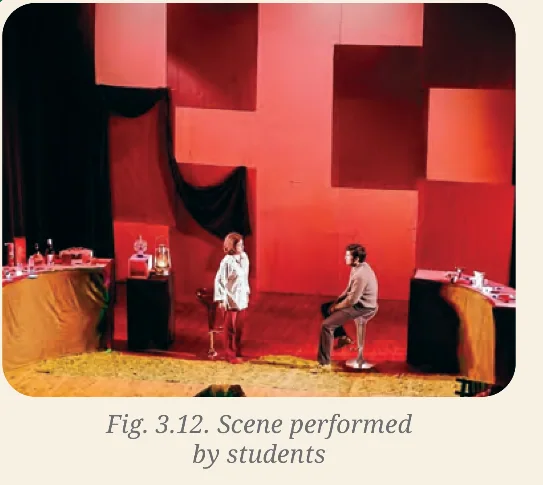
In the picture, different elements on the stage may represent different meanings:
| Thing shown on stage | What it may represent |
|---|---|
| Red background | Anger, danger, conflict, passion, or tension |
| Black cloth or dark area | Mystery, fear, sadness, hidden truth, or confusion |
| Large red panels | Pressure, emotional burden, or a difficult situation |
| Standing character in the centre | A person facing a challenge or speaking the truth |
| Sitting character | A person in power, control, or deep thought |
| Tables/objects on both sides | Different sides of society, choices, or responsibilities |
| Empty stage space | Loneliness, distance between people, or emotional gap |
| Bright light on the centre | Focus on the main character or main conflict |
Overall meaning:
The scene may be showing a serious conflict between two people or two ideas. The red and black colours create a mood of tension, danger, and mystery. The central character seems to be facing pressure, while the sitting character may represent authority or judgment. Overall, the stage is conveying a situation of conflict, fear, and emotional struggle.
Q2If you had to show a person growing in wisdom and intelligence over a period of 10 years, how would you show it? You are free to include costumes, lights, props, and music. No speech or dialogue can be used. Describe the visuals on stage. Doodles or drawings can also be used.
I would show the growth of wisdom and intelligence through changes in costume, light, props, movement, and music.
At the beginning, the person would enter wearing simple school clothes, carrying a small bag and a notebook. The light would be soft and pale yellow to show the beginning of learning. The person would move quickly and sometimes look confused, showing curiosity but lack of experience.
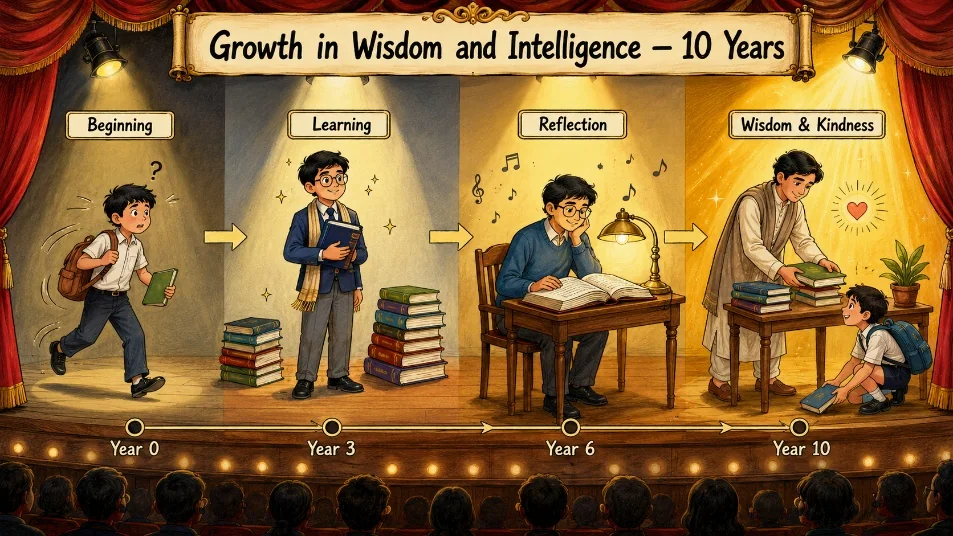
After some time, the lights would slowly become brighter. The character would add new costume pieces, such as a neat jacket, spectacles, or a shawl. The notebook would become thicker, and more books would appear on the stage. This would show increasing knowledge.
In the middle part, the character would sit under a lamp and read. The lamp would symbolise hope and learning. Slow and gentle instrumental music, such as flute or piano, would play in the background.
Towards the end, the person would wear mature and graceful clothes. The movements would become calm and confident. A warm golden spotlight would fall on the character. The person would place the books carefully on a table and help another young student pick up a fallen book. This action would show that true wisdom is not only knowledge, but also kindness and understanding.
Q3Assign one friend who you think represents each colour and explain why.
| Colour | Name of friend | Explanation |
|---|---|---|
| Yellow | Aarav | I think Aarav represents yellow because he is cheerful, hopeful, and always brings positive energy to the class. |
| Red | Priya | I think Priya represents red because she is confident, energetic, brave, and passionate about every activity. |
| Blue | Rohan | I think Rohan represents blue because he is calm, peaceful, thoughtful, and handles situations with patience. |
Students can replace these names with the names of their own friends.
Q4Why are symbolism and metaphors used on stage?
Symbolism and metaphors are used on stage to give deeper meaning to a performance. They help the audience understand emotions, ideas, and situations without depending only on dialogues. A colour, light, prop, costume, sound, or movement can represent something more than its literal meaning. For example, a lamp may symbolise hope, a closed door may symbolise fear or opportunity, and a torn costume may show a broken identity.
They also make theatre more creative, emotional, and visually powerful. Symbols allow the audience to think, imagine, and interpret the scene in their own way. This makes the performance more meaningful and memorable.
Open the separate notes / explanation page for this same chapter.
Open Notes / ExplanationReturn to the complete Madhurima chapter list.
View all chapters