
Complete discussion-circle and exercise answers for Chapter 5, covering direction styles, acting systems, stage divisions, improvisation, theatre departments, and performance practice.
Question Answers
Discussion Circle
Q1Discuss the difference in impact between the āṅgika and vāchika versions.
The āṅgika version uses body language, gestures, facial expressions, posture, and movement to express meaning. It creates a strong visual impact and helps the audience understand emotions even without words. For example, a sad character can show sadness through a bent body, slow walking, and a dull face.
The vāchika version uses voice, dialogue, tone, pitch, volume, and pauses. It creates impact through speech and sound. The audience understands the character’s feelings through the way lines are spoken.
So, āṅgika is powerful visually, while vāchika is powerful through voice. A good performance becomes more effective when both are used together.
Q2How did acting solo feel different from acting in a group?
Acting solo felt more challenging because the whole attention of the audience was on one actor. The actor had to use voice, body language, expressions, and imagination alone to keep the audience engaged.
Acting in a group felt more lively and supportive. In group acting, actors respond to one another, maintain timing, share space, and create the scene together. It needs teamwork, listening, and coordination.
Solo acting depends mainly on individual presence, while group acting depends on harmony and cooperation.
Question Answers
Exercises
Q1What are the different styles of direction? If you were to direct a play, what would be your style and why?
The different styles of direction are:
Realistic direction – In this style, the play looks and feels like real life. The characters speak naturally, and the emotions feel genuine.
Abstract or symbolic direction – In this style, ideas, images, colours, and symbols are used to tell the story.
Devised theatre – In this style, the play is created by the group during rehearsals instead of starting with a fixed script.
Script-based direction – In this style, the director follows a written script and brings the writer’s ideas alive on stage.
Collaborative direction – In this style, different creative people, such as directors, musicians, and choreographers, work together on one concept.
If I were to direct a play, I would choose realistic direction because it is easy for the audience to understand and connect with. Realistic scenes, natural dialogues, and believable emotions can make the audience feel that the story is close to real life.
Q2What are the nine stage divisions? If you were to plan the following scene, where would the characters be positioned on stage, based on the nine stage divisions?
Scene: We are in Chhatrapati Śhivājī Mahārājaʼs court, and a famous poet of a neighbouring state is visiting him.
Give positions on stage for — Chhatrapati Śhivājī Mahārāja, the famous poet, the in-house poets of Chhatrapati Śhivājī Mahārāja, and the royal guards escorting the poet. You can make a drawing to indicate stage positions.
The nine stage divisions are:
Upstage Right
Upstage Centre
Upstage Left
Stage Right
Centre Stage
Stage Left
Downstage Right
Downstage Centre
Downstage Left
For the court scene, I would place the characters like this:
Chhatrapati Śhivājī Mahārāja – Upstage Centre, seated on the throne, because he is the most important person in the court.
Famous poet of the neighbouring state – Centre Stage, facing Śhivājī Mahārāja, because he is the guest and the main focus of the scene.
In-house poets of Chhatrapati Śhivājī Mahārāja – Stage Right and Stage Left, seated on both sides of the court.
Royal guards escorting the poet – Downstage Right and Downstage Left, or near the entrance, showing that they have brought the poet into the court.
Simple stage drawing:
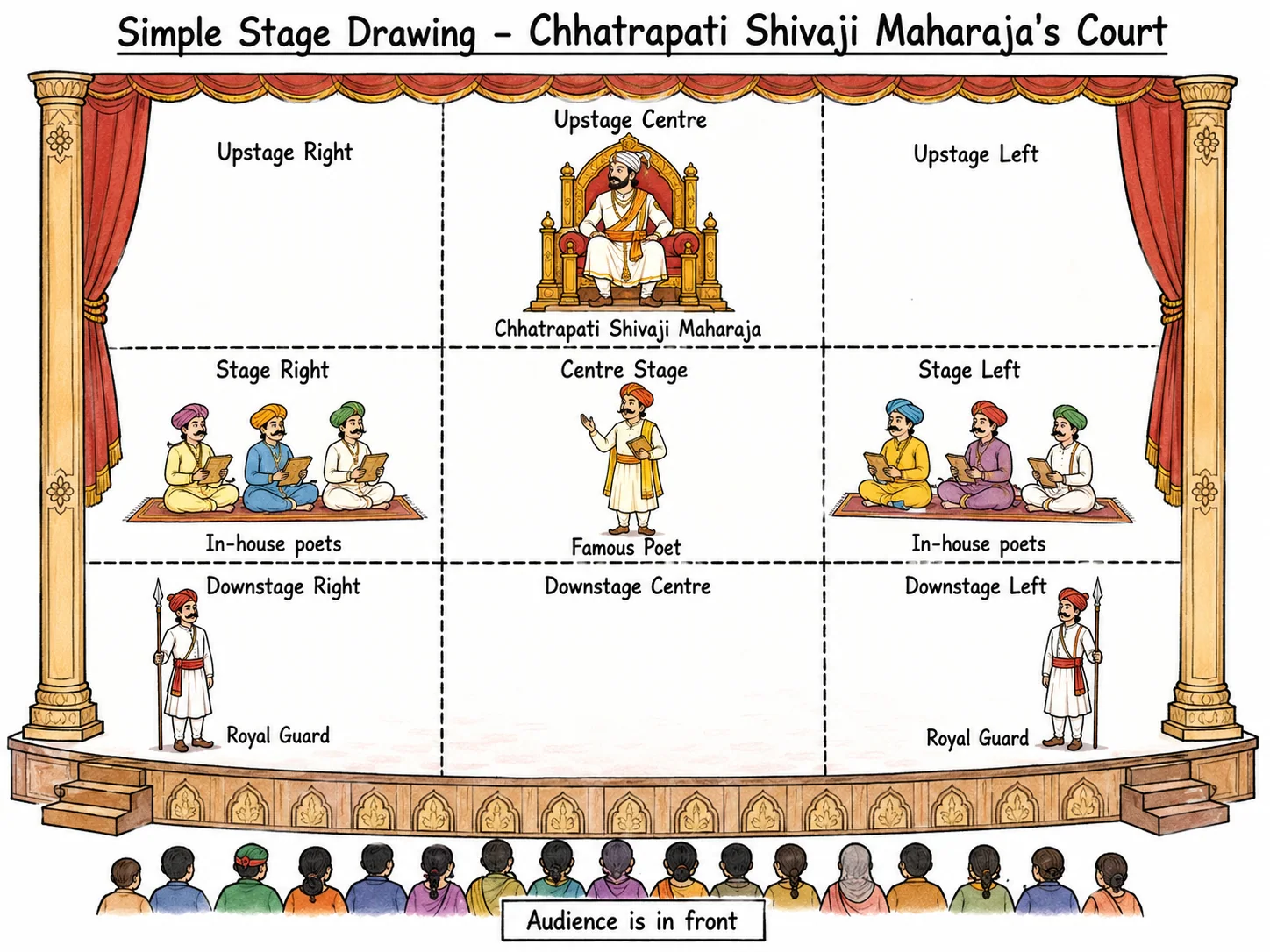
This arrangement shows Śhivājī Mahārāja’s royal position, gives importance to the visiting poet, and keeps the court balanced on stage.
Q3Which are the global schools of acting you have learnt about? Which one appeals to you the most and why?
The global schools of acting learnt in this chapter are:
The System and Method Acting – By Konstantin Stanislavsky and Lee Strasberg. It focuses on emotional truth, imagination, inner monologue, and commitment to the character.
Epic Theatre or Alienation Theory – By Bertolt Brecht. It keeps the actor slightly distant from the character so that the audience thinks deeply instead of only feeling emotions.
Poor Theatre – By Jerzy Grotowsky. It removes heavy sets, costumes, and props and focuses mainly on the actor’s body and performance.
Stella Adler’s Technique – By Stella Adler. It uses imagination rather than personal experience to build a strong character.
The school that appeals to me the most is The System and Method Acting because it helps an actor feel the character deeply and perform naturally. By using emotional truth and the “magic if”, an actor can make the performance more realistic and believable.
Q4Improvise and perform the following scene with:
just two people on stage;
atleast 5–6 on stage.
Scene: You are going to a shop to buy a notebook. You meet a friend from your childhood you havenʼt spoken to, for many years.
Note down the differences you felt in the scene as an actor and as an audience.
Scene with just two people on stage:
In this version, only two characters are present — one person going to buy a notebook and the childhood friend. The scene focuses mainly on their meeting, surprise, emotions, and conversation.
As an actor: It felt more personal and direct. I had to focus completely on my friend’s expressions, voice, and reactions. There were fewer distractions, so emotions became more important.
As an audience: The scene felt simple, clear, and emotional. The audience could easily understand the relationship between the two friends.
Scene with 5–6 people on stage: In this version, other people can be present, such as the shopkeeper, customers, students, or people passing by. These characters make the shop scene more lively and realistic.
As an actor: It required more coordination, timing, and awareness of space. I had to speak my lines while also reacting to the movement and sounds around me.
As an audience: The scene felt more real and energetic. The shop looked like a busy place, but the focus had to be maintained on the two childhood friends.
Main difference: With two people, the scene was emotional and focused. With 5–6 people, the scene became lively, realistic, and needed better teamwork.
Q5Which are the various departments in theatre that come together for a performance? As a director, and in what order would you like to work with these departments, starting with the script?
The various departments in theatre that come together for a performance are:
Script
Direction
Acting
Set design
Props
Costumes
Make-up
Music and sound
Lighting
Stage management and technical crew
As a director, I would work with these departments in the following order:
Script department – First, I would read and understand the script, its theme, characters, emotions, and message.
Acting department – Then, I would select actors and help them understand their characters.
Blocking and movement – I would decide the positions, entries, exits, and movements of actors.
Set design department – I would plan the stage space and background according to the story.
Props department – I would decide which objects are needed in each scene.
Costume and make-up department – I would plan the appearance of each character.
Music and sound department – I would choose suitable music, sound effects, and voice levels.
Lighting department – I would decide the lights to create mood, focus, and atmosphere.
Technical and stage management team – Finally, I would coordinate all technical work during rehearsals and performances.
This order helps the director move from the basic idea of the script to the complete performance on stage.
Q6Match the following.
| Indian Name | Description |
|---|---|
| i. Āṅgika | c. Body language |
| ii. Bhūta-kola | d. A divine folk tradition of Karnataka |
| iii. Gaura-līlā | a. Performance in Manipur |
| iv. Āhārya | b. Costume, jewellery, set, and props |
Open the separate notes / explanation page for this same chapter.
Open Notes / ExplanationReturn to the complete Madhurima chapter list.
View all chapters