
Think It Over
Question 1. Where does a cell come from?
Answer: A cell comes from a pre-existing cell through the process of cell division. According to the Cell Theory, new cells are formed only from already existing cells. In unicellular organisms, one cell divides to form new cells. In multicellular organisms, cells divide for growth, repair, and replacement of old or damaged cells.
Question 2. How have technological interventions facilitated the creation of new knowledge in understanding the world beyond the naked eye?
Answer: Technological interventions such as the invention and improvement of the microscope have helped scientists study objects that are too small to be seen with the naked eye. The light microscope made it possible to observe cells, and later the electron microscope revealed the fine details of cell structures at a much higher magnification and resolution. These tools greatly increased our understanding of cell structure and function.
Question 3. How is the cell structural and functional unit of life?
Answer: The cell is called the structural unit of life because all living organisms are made up of cells. It is called the functional unit of life because all basic life processes such as respiration, nutrition, excretion, growth, and reproduction take place in cells. In multicellular organisms, cells work together to form tissues, organs, and organ systems, but the cell remains the basic unit performing life functions.
Question 4. How does a cell multiply?
Answer: A cell multiplies by cell division. In this process, one parent cell divides to form new daughter cells. There are two major types of cell division: mitosis, which produces two identical daughter cells for growth and repair, and meiosis, which produces gametes with half the number of chromosomes for sexual reproduction.
What if … (Page 12)
Question. Mung bean seeds are kept in a concentrated solution after soaking in water for 12 hours. What will happen to them?
Answer: The soaked mung bean seeds will lose water and shrink. This happens because the concentrated solution outside the seeds has less water and more solute than the inside of the seed cells. So, water moves out of the seed cells by osmosis. As a result, the seeds become less swollen and may appear shrunken.
Pause and Ponder (Page 14)
Question 1. What argument would you give for the necessity of a cell wall in plants usually fixed in one place versus in animals usually moving from one place to the other?
Answer: Plants are usually fixed in one place and cannot move away from environmental stresses such as wind, rain, and mechanical pressure. Therefore, they need a rigid cell wall for support, protection, and maintaining shape. The cell wall also helps plants remain upright. Animals, on the other hand, move from place to place and need flexibility in their body cells. So, animal cells do not have a cell wall, which allows them to change shape more easily.
Question 2. What consequences would you predict for a plant cell if its cell wall were to become as flexible as a cell membrane?
Answer: If the cell wall of a plant cell became as flexible as the cell membrane, the plant cell would lose its rigidity and fixed shape. It would not be able to maintain firmness properly. As a result, plant parts like stems and leaves would become weak and may bend or collapse easily. The plant would also become less resistant to environmental stress.
Question 3. Why is it important to cut the two potato pieces in roughly equal size and measure their initial weight before placing them in different liquids?
Answer: It is important to use potato pieces of roughly equal size and to measure their initial weight so that the experiment remains fair and accurate. Equal-sized pieces provide similar surface area and amount of tissue, making comparison easier. Measuring the initial weight helps us know exactly how much weight is gained or lost after placing them in different liquids. This allows us to observe the effect of osmosis correctly.
Table 2.1: Comparison of different kinds of cells based on their structure
| S. No. | Cell structures | Bacterial cell | Plant cell | Animal cell |
|---|---|---|---|---|
| 1. | Cell membrane | Present | Present | Present |
| 2. | Cell wall | Present | Present | Absent |
| 3. | Cytoplasm | Present | Present | Present |
| 4. | Well-defined nucleus (genetic material enclosed by a membrane) | Absent | Present | Present |
| 5. | Primitive nucleus (nucleoid) (genetic material without membrane around it) | Present | Absent | Absent |
| 6. | Membrane-bound organelles | Absent | Present | Present |
Pause and Ponder (Page 19)
Question 4. Do white flowers contain any pigment? Give reasons.
Answer: Yes, some white flowers may contain pigments, but they do not have strong coloured pigments like red, yellow, or orange in large amounts. In many cases, white colour appears because coloured pigments are absent or present in very small amounts, so light is reflected and the flower appears white. Therefore, white flowers generally lack prominent chromoplast pigments that produce bright colours.
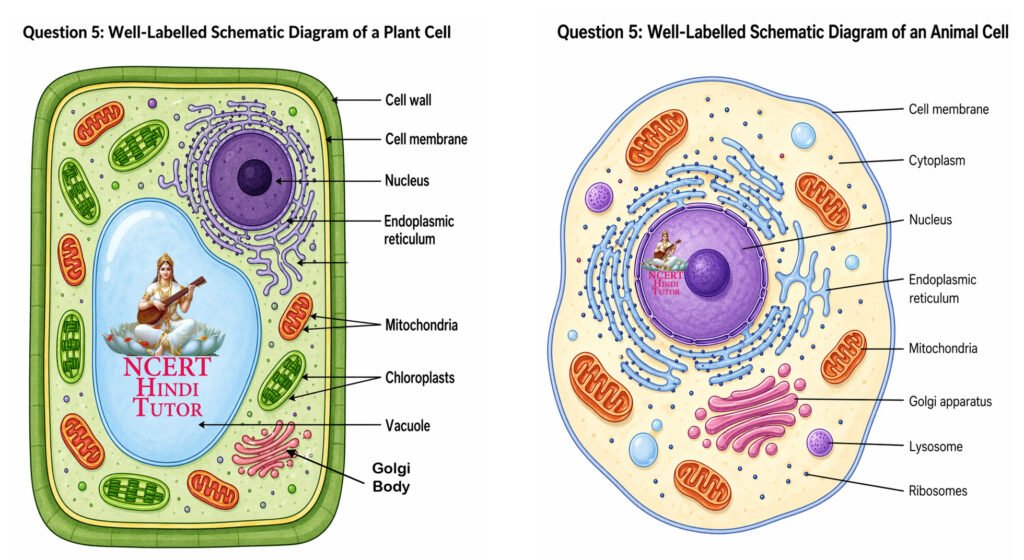
Question 5. Draw a well-labelled schematic diagram of a plant or an animal cell using these clues —
(i) Nucleus appears as a dark and round body inside the cell.
(ii) ER spreads like a network of extended nuclear envelope.
(iii) Mitochondria and chloroplasts are rod shaped.
You may refer to Fig. 2.10.
Answer: Here is a simple well-labelled schematic diagram of a plant cell:
Pause and Ponder (Page 22)
Question 6. Instead of many small ones, why does a cell not have a single giant mitochondrion? How does this relate to the concept of surface area?
Answer: A cell has many small mitochondria instead of one giant mitochondrion because many small organelles provide a greater total surface area compared to a single large one. More surface area allows more chemical reactions related to energy production to take place efficiently. It also helps in better distribution of mitochondria throughout the cell so that energy can be supplied wherever needed. Thus, having many small mitochondria is more effective than having one giant mitochondrion.
Question 7. If the skin cells start dividing by meiosis instead of mitosis, what do you think will happen to a cut on the skin?
Answer: If skin cells divide by meiosis instead of mitosis, the cut on the skin will not heal properly. This is because meiosis produces cells with half the number of chromosomes, which are meant for reproduction, not body repair. Skin repair requires mitosis, which produces identical body cells with the same chromosome number. So, normal healing and replacement of damaged skin cells would be disturbed.
Revise, Reflect, Refine
Question 1. Differentiate between the following pairs of terms based on the clues given in parentheses:
(i) Cell membrane and cell wall (permeability)
Answer:
- Cell membrane is selectively permeable, which means it allows only some substances to pass through it.
- Cell wall is freely permeable, which means water and some dissolved substances can pass through it more easily.
Question 1. Differentiate between the following pairs of terms based on the clues given in parentheses:
(ii) RER and SER (structure)
Answer:
- RER (Rough Endoplasmic Reticulum) has ribosomes attached on its surface, so it looks rough.
- SER (Smooth Endoplasmic Reticulum) does not have ribosomes on its surface, so it looks smooth.
Question 1. Differentiate between the following pairs of terms based on the clues given in parentheses:
(iii) Chloroplasts and chromoplasts (pigments)
Answer:
- Chloroplasts contain the green pigment chlorophyll.
- Chromoplasts contain coloured pigments other than chlorophyll, such as yellow, orange, or red pigments.
Question 2. Two similar animal cells are placed in two different solutions:
y Cell X is placed in pure water.
y Cell Y is placed in a concentrated salt solution.
Cells are observed after some time. Cell X swells, and Cell Y shrinks. Which statement provides the correct explanation for the above observations?
(i) Salt molecules moved into Cell Y, causing it to shrink.
(ii) Water moved into Cell X and more water moved out of Cell Y than the salt solution entered in it.
(iii) Water moved into Cell X and moved out of Cell Y through the cell membrane.
(iv) Solute movement caused osmosis in both cells.
Answer: The correct option is (iii) Water moved into Cell X and moved out of Cell Y through the cell membrane.
In pure water, water enters Cell X by osmosis, so it swells. In concentrated salt solution, water moves out of Cell Y by osmosis, so it shrinks.
Question 3. Look at the diagram of a cell in Fig. 2.20. Identify the parts labelled from (a) to (g) and correctly match them with their functions given below:
(i) Controlling all the activities of a cell.
(ii) Site of cellular respiration.
(iii) Storage organelle that also provides rigidity to the cell.
(iv) Separates the cell contents from surroundings.
(v) Provides structural rigidity to the cell.
(vi) Packs and stores materials received from ER.
(vii) Helps in manufacturing food.
Answer: The labelled parts and their functions are:
- (a) Cell wall — (v) Provides structural rigidity to the cell
- (b) Cell membrane — (iv) Separates the cell contents from surroundings
- (c) Nucleus — (i) Controlling all the activities of a cell
- (d) Chloroplast — (vii) Helps in manufacturing food
- (e) Mitochondrion — (ii) Site of cellular respiration
- (f) Vacuole — (iii) Storage organelle that also provides rigidity to the cell
- (g) Golgi apparatus — (vi) Packs and stores materials received from ER
Question 4. Which of the following option(s) of the pairs of cell organelles are correctly placed under the given categories?
Option | Present in the plant cells | Absent in the animal cells
(i) Leucoplast | Cell wall
(ii) Mitochondria | Ribosome
(iii) Cell wall | Golgi apparatus
(iv) Lysosome | Endoplasmic reticulum
Answer: The correct option is (i) only.
Reason:
- Leucoplast is present in plant cells.
- Cell wall is absent in animal cells.
The other options are incorrect because mitochondria, ribosomes, Golgi apparatus, and endoplasmic reticulum are also found in animal cells.
Question 5. Two students, Renu and Rohit, were having a discussion on the plastids. Renu emphasised that all parts of the plants, even roots, contain plastids. However, Rohit did not agree with the statement and told her that plastids are absent in plant roots since the roots are underground and do not need to perform photosynthesis. Who is correct? Justify your answer.
Answer: Renu is correct.
Plastids are of different types. Roots usually do not contain chloroplasts because they do not perform photosynthesis, but they can contain leucoplasts, which are colourless plastids used for storing food such as starch, oils, or proteins. Therefore, plastids are present even in roots, but they are usually not the green photosynthetic plastids.
Question 6. Mitochondria and chloroplasts are two important organelles in a plant cell. Discuss how these two organelles are structurally and functionally similar to each other, and different from each other.
Answer:
Similarities:
- Both are double-membrane-bound organelles.
- Both have their own DNA and ribosomes.
- Both are involved in important energy-related processes in the cell.
Differences:
- Mitochondria are the sites of cellular respiration and release energy in the form of ATP.
- Chloroplasts are the sites of photosynthesis and prepare food using sunlight.
- Mitochondria are found in both plant and animal cells, while chloroplasts are mainly found in plant cells.
- Chloroplasts contain chlorophyll, while mitochondria do not.
Question 7. Which of the following pairs of cell organelles contains DNA?
(i) Chloroplasts, Ribosomes
(ii) Mitochondria, Nucleus
(iii) Golgi bodies, Ribosomes
(iv) Nucleus, Lysosomes
Answer: The correct option is (ii) Mitochondria, Nucleus.
Both the nucleus and mitochondria contain DNA. Ribosomes, Golgi bodies, and lysosomes do not contain DNA.
Question 8. A researcher carried out an experiment in which she took two carrots of similar size. She placed one carrot in plain water and the other carrot in concentrated salt solution (Fig. 2.21). After 24 hours she recorded her observations.
(i) What hypothesis does she want to test through this experiment?
Answer: She wants to test the hypothesis that water moves in and out of plant cells by osmosis depending on the concentration of the surrounding solution. A carrot in plain water should gain water and remain stiff, while a carrot in concentrated salt solution should lose water and become limp.
(ii) What would you suggest for the improvement of this experiment?
Answer: The experiment can be improved by:
- taking carrots of equal size and weight,
- measuring their initial and final weights,
- repeating the experiment for accuracy, and
- keeping all other conditions such as time and temperature the same.
(iii) Why does the carrot in plain water stay stiff and crunchy, but the carrot in concentrated salt solution become rubbery and limp?
Answer: In plain water, water enters the carrot cells by osmosis, making them turgid, stiff, and crunchy. In concentrated salt solution, water moves out of the carrot cells by osmosis, so the cells lose firmness and the carrot becomes rubbery and limp.
Question 9. Indicate the presence or absence of following structures in bacterial and animal cells:
| Structures in a cell | Bacterial cell | Animal cell |
|---|---|---|
| Chromosome | Present | Present |
| Nucleus | Absent | Present |
| Mitochondria | Absent | Present |
| Golgi complex | Absent | Present |
| Chromoplasts | Absent | Absent |
Answer:
The completed table is:
| Structures in a cell | Bacterial cell | Animal cell |
|---|---|---|
| Chromosome | Present | Present |
| Nucleus | Absent | Present |
| Mitochondria | Absent | Present |
| Golgi complex | Absent | Present |
| Chromoplasts | Absent | Absent |
Bacterial cells are prokaryotic and do not have membrane-bound organelles, while animal cells are eukaryotic and have these structures. Chromoplasts are plastids found in plant cells, not in bacteria or animals.
Question 10. Carry out the following experiment:
Take four peeled potato halves and scoop each one out to make potato cups. One of these potato cups should be made from a boiled potato. Place each of the potato cups in a beaker containing water (Fig. 2.22). Now, set up the experiment as follows:
(a) Keep Cup A empty.
(b) Add one teaspoon sugar in Cup B.
(c) Add one teaspoon salt in Cup C.
(d) Add one teaspoon sugar in the boiled potato in Cup D.
Observe the four potato cups at least two hours and answer the following questions:
(i) Explain why water gathers in the hollowed portion of Cup B and Cup C.
Answer: Water gathers in the hollowed portion of Cup B and Cup C because sugar and salt make the solution inside the cup more concentrated than the surrounding water. Due to osmosis, water moves through the living potato tissues into the hollow portion, where it collects.
(ii) Why is Cup A necessary for this experiment?
Answer: Cup A is necessary as a control. It shows that without sugar or salt, water does not collect in the hollow. This helps us compare the results and confirm that water collection in Cups B and C happens because of osmosis.
(iii) Explain why water does not gather in the hollowed portions of Cups A and D.
Answer:
- In Cup A, there is no sugar or salt to create a concentration difference, so osmosis does not occur in a way that collects water in the hollow.
- In Cup D, the potato is boiled, so its cell membranes are damaged and are no longer selectively permeable. Therefore, osmosis cannot take place properly.
Question 11. Identify the pair that incorrectly matches the cell organelle with its function.
(i) Ribosome — Protein synthesis
(ii) SER — Lipid and cellulose synthesis
(iii) Lysosome — Digestion of foreign agents
Answer: The incorrectly matched pair is (ii) SER — Lipid and cellulose synthesis.
Reason: SER helps in the synthesis of lipids and some hormones, but not cellulose synthesis. Cellulose forms the plant cell wall and is not synthesised by SER in the way stated here.
Question 12. What outcome do you expect, if all the mitochondria are removed from a eukaryotic cell?
Answer: If all mitochondria are removed from a eukaryotic cell, the cell will not be able to produce enough ATP, which is the main energy currency of the cell. As a result, most cellular activities will stop, and the cell may eventually die due to lack of energy.
Question 13. Which phenomenon inhibits the formation of tumors in the human body? Can plants also develop tumors? Explain.
Answer: The phenomenon that inhibits the formation of tumors in the human body is contact inhibition. In many animal cells, cell division stops when cells come in contact with neighbouring cells. This prevents uncontrolled growth.
Yes, plants can also develop tumors. However, plant cells do not show contact inhibition in the same way as animal cells because of their rigid cell walls and different growth pattern. Abnormal growth can still occur in plants under certain conditions, such as infection or uncontrolled cell division.
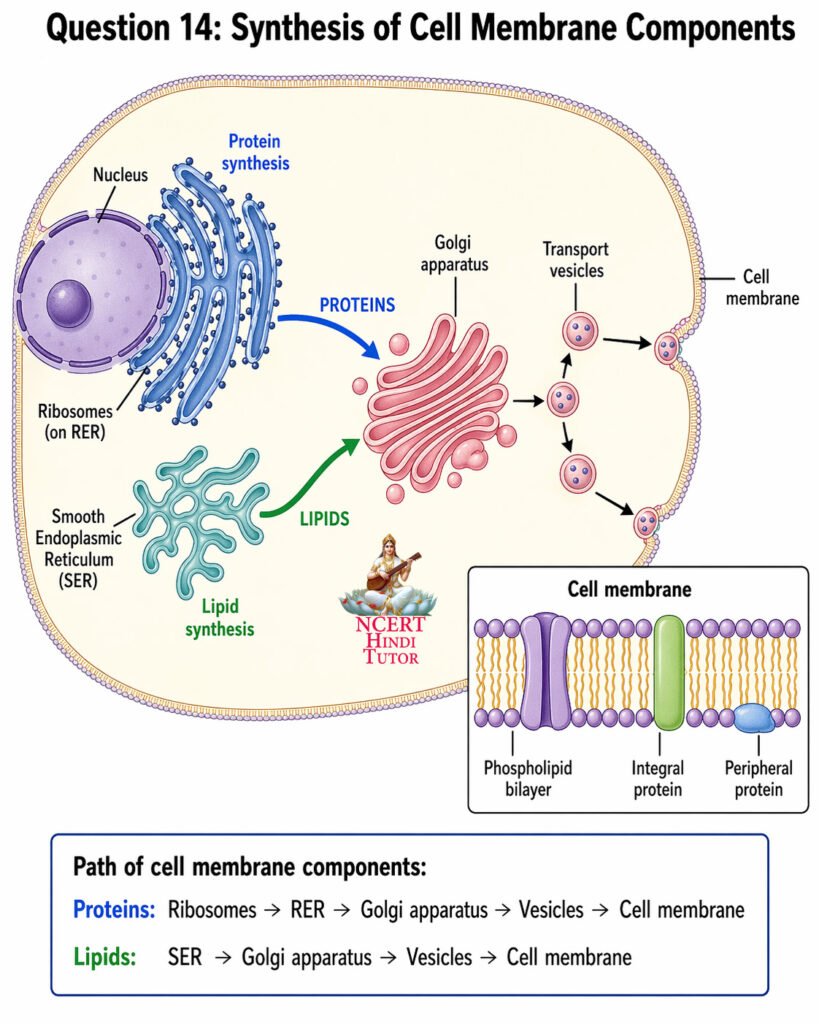
Question 14. The cell membrane of a cell is made up of proteins and lipids. Which cell organelles help in the synthesis of cell membrane? Write the path of these compounds from their site of synthesis to the cell membrane and show this through a labelled diagram.
Answer: The cell organelles involved in the synthesis of the cell membrane are:
- Ribosomes and RER for proteins
- SER for lipids
- Golgi apparatus for modification, packaging, and transport to the cell membrane
Path of membrane components:
- Proteins: Ribosomes → RER → Golgi apparatus → Vesicles → Cell membrane
- Lipids: SER → Golgi apparatus → Vesicles → Cell membrane
Labelled diagram:
Question 15. What would happen if gametes are formed by mitotic divisions?
Answer: If gametes are formed by mitotic divisions, they will have the same number of chromosomes as the parent cell instead of half. Then, during fertilisation, the chromosome number would become double in the offspring. This would disturb the normal chromosome number of the species and create serious genetic imbalance. Therefore, gametes must be formed by meiosis, not mitosis.
Question 16. A farmer, Deepa, was very happy with the harvest of amla (Indian Gooseberry) and lemons on her farm. However, she could sell only one-fourth of the produce in the local market. Recognising that a significant amount of produce may be lost post-harvest, she employed a traditional yet scientifically sound method to extend the shelf life of amla and lemons. She turned perishable produce into profitable products, such as pickles and sharbat. She used the excess produce to prepare pickles, murabbas, and sharbat by adding appropriate amounts of salt, sugar, or jaggery to small pieces of fruit and their juices. These were then stored in small glass bottles for sale, helping her prevent the wastage of post-harvest produce. This shift from farming to agro-processing would strengthen food security and boost the local economy, creating a sustainable model that cuts waste while increasing her income. Based on the above passage answer the following questions:
(i) Which scientific concept has the farmer applied in the preservation of the farm produce?
Answer: The farmer has applied the scientific concept of osmosis in food preservation. High concentrations of salt and sugar draw water out of microbial cells, preventing their growth.
(ii) How does the addition of high concentrations of salt and sugar create an environment that prevents the growth of spoilage-causing bacteria and fungi?
Answer: High concentrations of salt and sugar create a hypertonic environment around bacteria and fungi. Water moves out of their cells by osmosis, causing them to shrink and lose the water needed for survival and growth. As a result, spoilage-causing microorganisms cannot grow properly.
(iii) Suggest a healthy recipe of this kind for food preservation.
Answer: One healthy recipe is lemon pickle with salt or amla murabba with moderate jaggery. These can be prepared hygienically and stored in clean glass jars to increase shelf life while preserving nutrients.
(iv) What are the scientific values addressed in this case?
Answer: The scientific values addressed in this case are:
- proper use of scientific knowledge in daily life,
- prevention of food wastage,
- resource management,
- innovation in preservation,
- self-reliance, and
- promoting sustainability and local economy.
The Quest Conitues – Page 27
Question. What is the future of the development of synthetic cells using non-living chemicals? If a synthetic cell is developed, what may be the related ethical issues?
Answer: The future of developing synthetic cells from non-living chemicals is very promising. Scientists hope that such cells may help us understand how life began on Earth and how simple chemicals became organised into living systems. In the future, synthetic cells may be used in medicine to deliver drugs to specific parts of the body, in industry to produce useful chemicals, and in environmental work to break down pollutants. They may also help scientists study cell functions in a simpler and more controlled way.
However, if a synthetic cell is developed, several ethical issues may arise. One concern is biosafety, because such cells should not harm humans, animals, plants, or the environment. Another issue is biosecurity, meaning that this technology should not be misused for harmful purposes. There is also the question of human responsibility: how far should humans go in creating life-like systems in laboratories? Scientists would need strict rules, transparency, and careful testing before using synthetic cells widely. So, while synthetic cells may be very useful, their development must be guided by science, ethics, and social responsibility.
